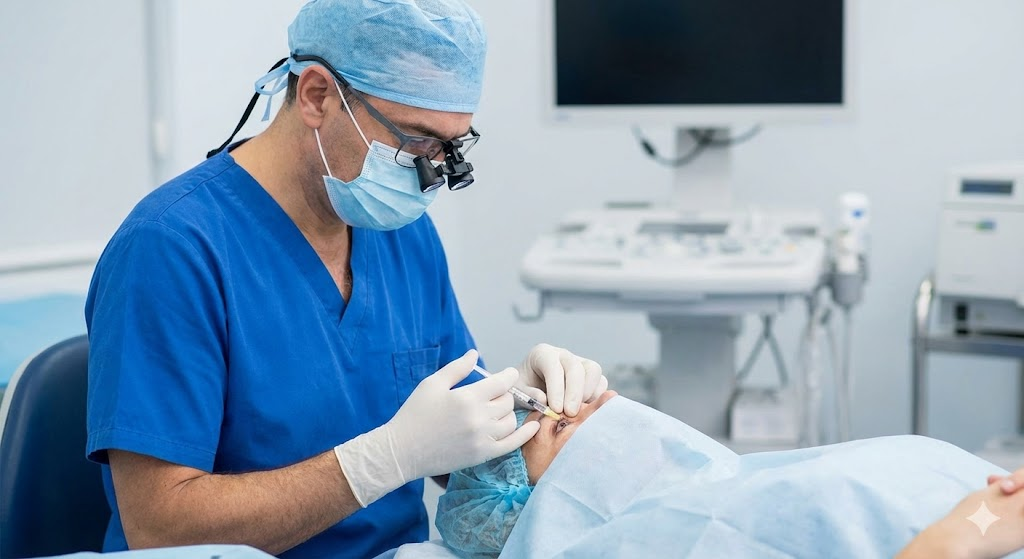
In my practice as an ophthalmologist, few moments cause as much immediate, visible anxiety in a patient as when I utter the phrase: “We need to perform an injection into your eye.”
The reaction is entirely natural. The eye is one of our most sensitive organs, and the idea of a needle approaching it goes against every instinct we have.
However, as a medical professional specializing in retinal disease, my perspective is vastly different. I see the intravitreal injection (IVI) not as an ordeal, but as one of the most miraculous advancements in modern medicine. It is a procedure that has single-handedly transformed diagnoses that once meant certain blindness into manageable chronic conditions.
The purpose of this article is to bridge the gap between that instinctive fear and the clinical reality, explaining the science of why we do this, what is actually happening, and why it remains the gold standard for treating retinal disease.
The Biological Challenge: The Blood-Retina Barrier
Patients often ask, “Can’t I just use eye drops or take a pill?”
It is an excellent question with a firm physiological answer: No.
The human eye is an evolutionary marvel protected by something called the Blood-Retina Barrier (BRB). This is a tightly regulated filtration system that prevents harmful substances in your bloodstream from entering the delicate neural tissue of the retina at the back of the eye.
Unfortunately, the BRB is so efficient that it also keeps out most systemic medications taken orally. Furthermore, eye drops only penetrate the front surface of the eye (the cornea); they cannot reach the retina in therapeutic concentrations.
Therefore, when dealing with diseases located at the very back of the eye, the only way to achieve a therapeutic dose of medication exactly where it is needed is to bypass the barrier and place the drug directly into the vitreous cavity—the jelly-filled space in the middle of the globe.
What We Are Treating: The “Leaky Pipe” Problem
Intravitreal injections are primarily used to treat diseases characterized by abnormal blood vessel growth (angiogenesis), vascular leakage, or severe inflammation in the retina.
The most common indications are:
- Wet Age-Related Macular Degeneration (AMD): Where abnormal vessels grow under the macula and leak fluid and blood.
- Diabetic Macular Edema (DME): A complication of diabetes where high blood sugar damages retinal vessels, causing them to leak fluid and swell the retina.
- Retinal Vein Occlusion (RVO): A blockage in a vein carrying blood away from the retina, leading to back-pressure, hemorrhage, and swelling.
In all these conditions, the structural integrity of the retina is compromised by fluid accumulation, leading to rapid and often permanent vision loss if left untreated.
The Pharmacology: The Drugs We Use
The medications we inject are bio-engineered proteins designed to target specific disease pathways at a molecular level.
1. Anti-VEGF Agents (e.g., Eylea, Lucentis, Vabysmo, Avastin) In conditions like wet AMD and diabetic eye disease, the oxygen-starved retina releases a protein called Vascular Endothelial Growth Factor (VEGF). VEGF acts as a distress signal, triggering the growth of new, fragile blood vessels that tend to leak.
Anti-VEGF drugs act like a sponge. They bind to the VEGF protein, blocking the signal. This stops new vessel growth and, crucially, causes existing leaky vessels to dry up, allowing the retinal swelling to resolve.
2. Intravitreal Steroids (e.g., Ozurdex, Triesence) For conditions driven primarily by inflammation (such as certain types of edema or uveitis), we inject potent corticosteroids. These reduce inflammation and stabilize leaky blood vessels, often lasting longer in the eye than anti-VEGF drugs.
The Procedure: A Clinical Walkthrough
The anxiety regarding IVIs usually stems from the unknown. Let’s demystify the actual patient experience, which typically takes less than 10 minutes in the office.
- Anesthesia (Numbing): This is the most critical step for patient comfort. We use strong topical anesthetic drops or a gel to completely numb the surface of the eye. Most patients report feeling pressure during the procedure, but rarely sharp pain.
- Sterilization: To prevent infection, the eye and eyelids are cleaned thoroughly with povidone-iodine (Betadine), a powerful antiseptic.
- The Injection Site (The Pars Plana): We do not inject randomly. We target a specific anatomical zone called the pars plana. This is a safe zone located roughly 3.5mm to 4mm behind the colored part of the eye (limbus), where there is no retina and no lens, minimizing risk to ocular structures.
- The Injection: Using a very fine-gauge needle (often smaller than a human hair), the medication is injected quickly into the vitreous. The actual injection takes only a few seconds. You might see medication floating in your vision immediately afterward.
Risks and Safety Profile
As with any invasive medical procedure, IVIs carry risks that must be weighed against the benefit of saving sight.
The most serious risk is endophthalmitis, a bacterial infection inside the eye. Because of rigorous sterile protocols, this is exceedingly rare occurring in roughly 1 in every 3,000 to 5,000 injections.
More common, transient side effects include:
- Subconjunctival Hemorrhage: A red spot on the white of the eye where the needle entered. It looks alarming but is harmless and resolves like a bruise over a week or two.
- Floaters: You may see transient bubbles or swirls in your vision for a few days as the medication disperses.
- Temporary Pressure Spike: Intraocular pressure may rise temporarily immediately after the injection but usually normalizes quickly.
Conclusion
The intravitreal injection is a procedure where the anticipation is almost always worse than the reality. It is a highly refined, scientifically sound intervention that allows us to deliver potent therapies directly to the site of disease, bypassing the body’s natural barriers.
While nobody enjoys getting an injection, I encourage my patients to reframe the experience: that momentary pressure is the feeling of sight being preserved for years to come.