Oculoplasty
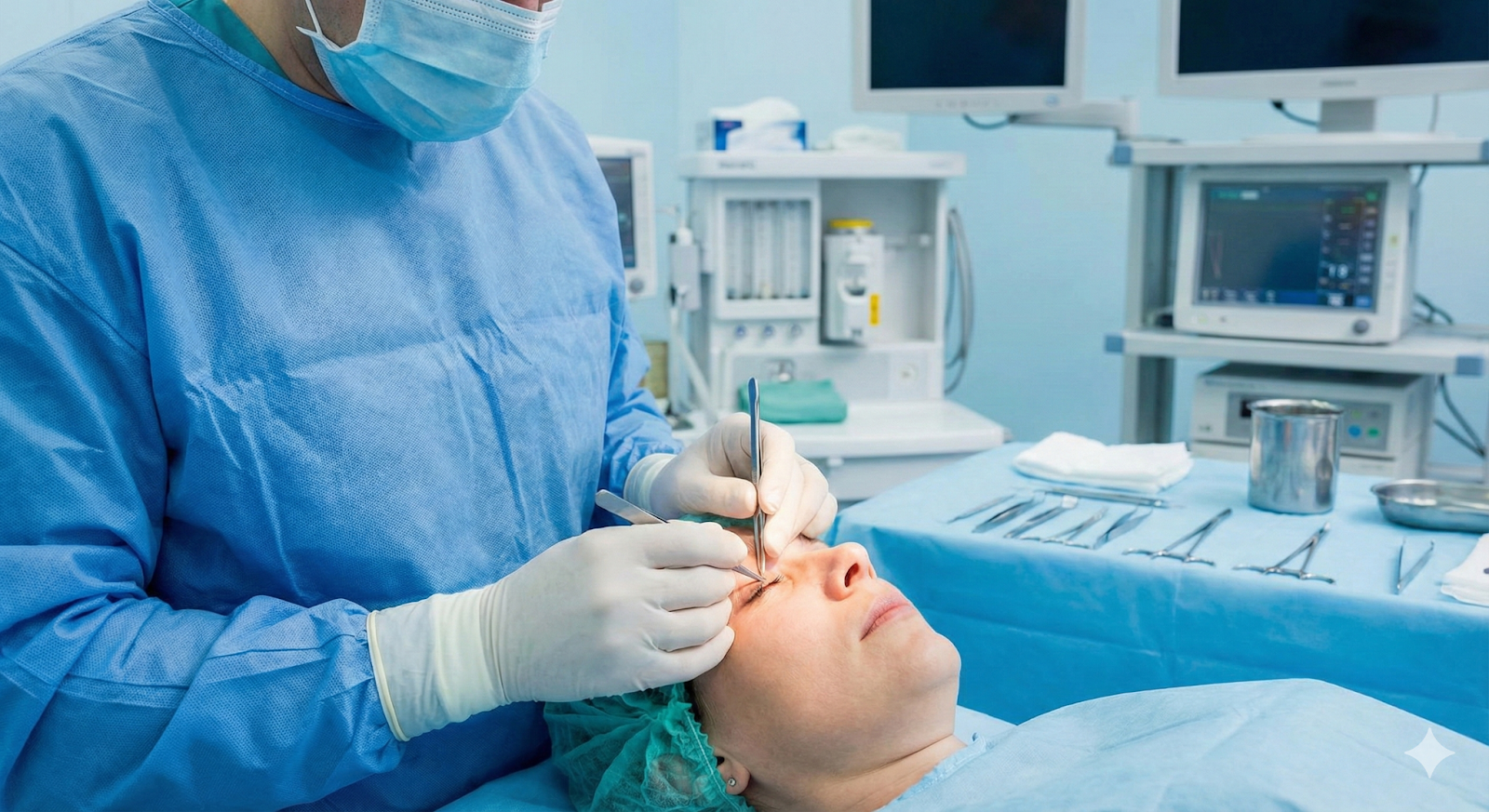
Oculoplasty
Restoring Your Function & Redefining Your Look.
Oculoplasty is the specialized fusion of ophthalmology and reconstructive plastic surgery. It deals with the structures surrounding the eyeball: the eyelids, the tear ducts (lacrimal system), and the eye socket (orbit). Whether for functional correction or cosmetic rejuvenation, our goal is to protect your vision while ensuring a natural, symmetric appearance.
Overview
Ptosis is a condition where the upper eyelid droops downwards. It can be mild (cosmetic concern) or severe (covering the pupil and blocking vision). It gives the patient a constantly “tired” or “sleepy” appearance.
Who is at Risk?
- Aging: The muscle responsible for lifting the lid (Levator muscle) stretches and weakens over time.
- Congenital: Children born with weak eyelid muscles (requires early correction to prevent lazy eye).
- Trauma/Neurological: Injury to the eye or nerve palsy.
Symptoms
- Visual Field Loss: The upper part of your vision is blocked by the lid.
- Forehead Wrinkles: Unconsciously raising eyebrows to lift the heavy lids.
- Neck Pain: Tilting the head back to see clearly.
Treatment Options
- Levator Resection: Tightening the primary muscle that lifts the lid.
- Frontalis Sling Surgery: Using a synthetic or natural material to connect the eyelid to the forehead muscles (for severe cases with poor muscle function).
Overview
A blockage in the drainage pipe (nasolacrimal duct) that carries tears from the eye to the nose. When blocked, tears overflow onto the cheek, and the stagnant fluid becomes a breeding ground for bacteria (Dacryocystitis).
Who is at Risk?
- Age/Gender: More common in middle-aged women.
- Newborns: Many babies are born with a blocked valve (often resolves with massage).
- Nasal Issues: Chronic sinus infections or broken noses.
Symptoms
- Epiphora: Excessive, embarrassing watering of the eyes, even indoors.
- Discharge: Sticky pus or mucus in the corner of the eye.
- Swelling: A painful lump near the side of the nose (lacrimal sac infection).
Treatment Options
- DCR Surgery (Dacryocystorhinostomy): Creating a new bypass tunnel for tears to drain into the nose.
- Endoscopic DCR: A scarless technique performed through the nose (no external cut on the face).
- Syringing & Probing: For infants, opening the membrane blockage with a fine wire.
Overview
As we age, eyelid tendons become lax, causing the lid to turn incorrectly.
- Entropion: The lid turns inward, causing eyelashes to rub against the cornea.
- Ectropion: The lid turns outward, leaving the eye exposed and dry.
Who is at Risk?
- Elderly: Due to tissue laxity.
- Scarring: Previous chemical burns or surgeries.
- Facial Palsy: Bell’s Palsy patients (Ectropion).
Symptoms
- Foreign Body Sensation: Feeling like something is constantly scratching the eye (Entropion).
- Redness & Tearing: Chronic irritation.
- Exposure Keratitis: The eye cannot close fully, risking corneal ulcers (Ectropion).
Treatment Options
- Lid Tightening Surgery: Lateral Tarsal Strip procedure to tighten the eyelid tendon.
- Retractor Plication: Re-attaching the muscles to restore the correct eyelid position.
Overview
Aesthetic procedures designed to rejuvenate the area around the eyes, removing “baggy” eyelids and wrinkles to restore a youthful, alert look.
Who is at Risk?
- Genetics: Family history of under-eye bags.
- Aging: Loss of skin elasticity and fat prolapse (herniation).
- Lifestyle: Sun exposure and smoking.
Symptoms
- Puffy Bags: Fat deposits under the eyes that don’t go away with sleep.
- Hooding: Excess skin on the upper lid that ruins eye makeup or sits on the lashes.
- Crow’s Feet: Dynamic wrinkles at the corners of the eyes.
Treatment Options
- Blepharoplasty: Surgical removal of excess skin and sculpting of fat pockets (Upper and Lower lids).
- Botox: Injections to relax muscles and smooth out wrinkles.
- Dermal Fillers: To fill hollows (tear troughs) under the eyes.
Overview
We utilize minimally invasive technology for maximum precision:
- Radiofrequency (RF) Unit: For cutting and coagulation, resulting in minimal bleeding and faster recovery than traditional scalpels.
- Nasal Endoscopy: To visualize the tear duct opening from inside the nose during DCR.
- Exophthalmometry: To measure the protrusion of the eyeball in Thyroid Eye Disease.
Patient FAQs
Will eyelid surgery leave a visible scar?
The eyelid skin is the thinnest in the body and heals exceptionally well. Incisions are usually hidden in the natural crease of the lid or inside the eyelid, making scars virtually invisible after healing.
Is Blepharoplasty just for vanity?
Not always, in many seniors, the upper eyelid skin sags so much (Dermatochalasis) that it blocks peripheral vision. In these cases, the surgery is functional and medically necessary.
Does DCR surgery require breaking a bone?
Yes, a tiny window is made in the thin nasal bone to bypass the blockage. However, this is painless post-surgery and does not change the shape or structure of your nose.
Revitalize your eyes, whether it’s a watering eye or a desire for a younger look, trust a specialist who knows the anatomy of the eye best.